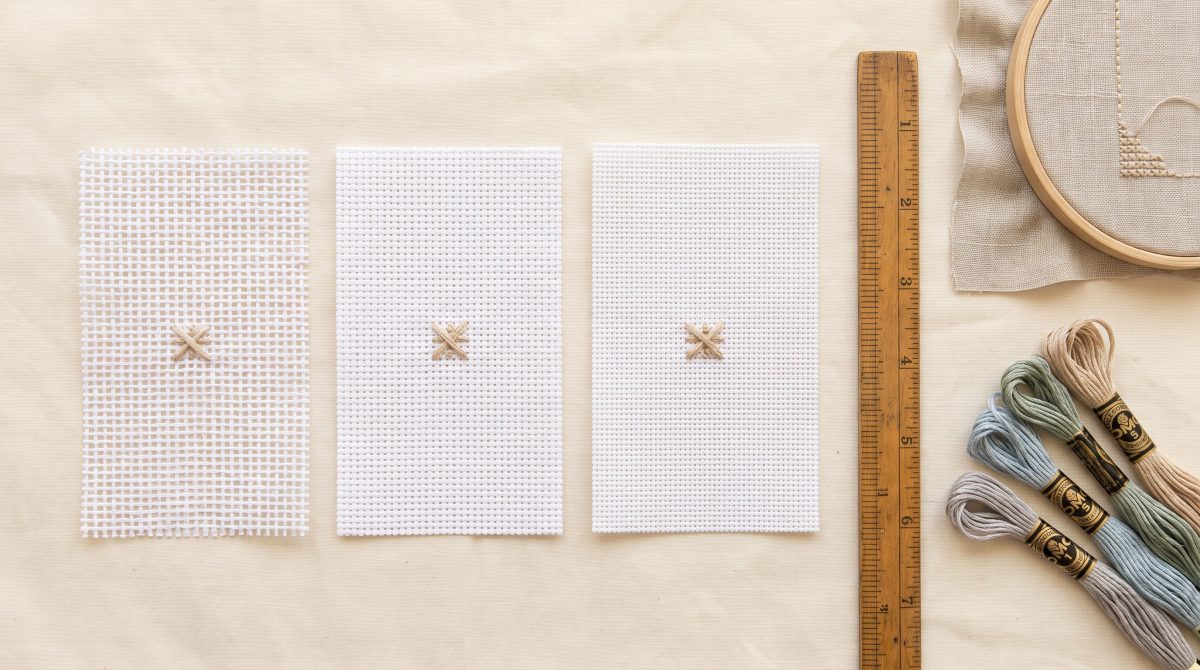
The short answer: 14-count suits almost everyone starting out, 16-count makes the same chart roughly 12% smaller and handles detail a little more finely, and 18-count shrinks the work by about a quarter and asks for good light. The only difference between Aida 14, 16 and 18 is how many squares fit in an inch. The chart itself doesn't change — the finished size, the thread you use and the strain on your eyes do.
Below: how count affects size, when a finer fabric genuinely helps and when it only adds fatigue, and three questions worth answering before you buy.
What count means and how it changes the finished size
Count is the number of squares per inch of fabric — 2.54 cm. Aida 14 has fourteen of them, Aida 18 has eighteen. The larger the number, the smaller the squares, and the less room the same design occupies.
One formula covers it: divide the stitch count by the fabric count for inches, then multiply by 2.54 for centimetres. Here's how a 100×140 design behaves:
| Fabric | Squares per inch | Size of a 100×140 design | Strands | Needle | Who it suits |
|---|---|---|---|---|---|
| Aida 14 | 14 | 7.1×10 in (18.1×25.4 cm) | 2 | Size 24 | Beginners, and anyone stitching in long sessions |
| Aida 16 | 16 | 6.3×8.8 in (15.9×22.2 cm) | 2 | Size 24–26 | Stitchers wanting a more compact result without changing habits |
| Aida 18 | 18 | 5.6×7.8 in (14.1×19.8 cm) | 1–2 | Size 26 | Experienced stitchers, fine detail and miniatures |
One detail worth holding onto: the number of stitches doesn't change. On 18-count you still make the same fourteen thousand stitches, just across a smaller area — the work won't go faster, even though it looks more compact. Speed follows stitch count, not fabric size.
Thread use shifts slightly in your favour on finer fabric, since each stitch spans a shorter distance and a skein stretches over more of them. The saving is real but modest, and it rarely outweighs the other considerations below.
Aida 14: the general-purpose starting point
Fourteen count stays the most common choice for practical reasons rather than tradition. The squares are visible without strain even in the evening, two strands of floss cover the fabric fully, and mistakes are easy to unpick because the stitches are large and the thread path is obvious.
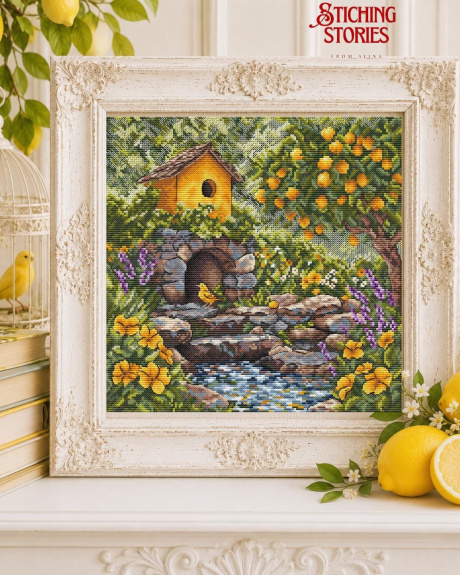
There's a flip side. Large subjects on 14-count take up serious space: a 250×300 design becomes a piece of roughly 18×21 in (45×54 cm), which calls for a frame rather than a hoop. Fine details — a bird's eye, thin branches, lettering — look blunt on large squares, simply because there aren't enough "pixels" available.
Aida 16 and 18: when a finer count earns its place
16-count — a cautious step
Sixteen count reduces the work by about twelve per cent while barely changing your habits: the same two strands usually give solid coverage, and a size 24 or 26 needle works. It's a sensible option when 14-count suits you fine but one particular design won't fit the frame you have.
18-count — for detail and miniatures
Eighteen count shrinks the same chart by roughly a quarter. The gain isn't really compactness, it's resolution: backstitch outlines sit more precisely, fractional stitches read more cleanly, and gradients built from close shades stop breaking into visible steps.
The cost is attention. The squares are small, so you need side lighting and sometimes a magnifier lamp, and coverage has to be tested: two strands give a dense but slightly padded surface, one strand gives a lighter result that may let fabric show through. The reliable answer is a test square of ten by ten stitches on a scrap, checked in daylight.
What count Aida for cross stitch: three questions before buying
Rather than hunting for a universal answer, it's easier to answer three specific questions.
How long can you stitch comfortably, and what's your lighting like? If an evening session runs an hour or two under a desk lamp, 14 or 16 count protects both your eyes and your enjoyment. Fine fabric under weak light turns a hobby into work quickly.
Is the size tied to a frame? When the frame is already bought or the wall space is fixed, count becomes a fitting tool. Calculate the size on 14, 16 and 18, then pick the one that fits with room for a mount.
What dominates the design? Large blocks of colour — botanical silhouettes, geometry, lettering — look good on 14-count. Heavy outlining, small details and smooth transitions come into their own on 16 or 18. If the stitches themselves are still new, look first at how the cross stitch is formed and how to secure the thread, and move to a finer count after that.
A note on colour: white and cream Aida stay neutral against any palette, while dark fabric demands denser coverage and gives you less contrast to count against. And if you're curious about evenweave or linen, the rule of thumb is simple — 28-count worked over two fabric threads gives roughly the same density as Aida 14.
A checklist before buying fabric
- Stitch count copied from the information page of the PDF.
- Finished size calculated for 14, 16 and 18 — not just for one of them.
- 2–3 in (5–7 cm) added on every side of the chosen size for hoop and framing.
- Needle matched to the count: size 24 for 14, 24–26 for 16, 26 for 18.
- Strand count confirmed with a test square if the count is new to you.
- Fabric colour chosen to suit the palette, rather than the other way round.
- Lighting at your stitching spot assessed honestly — it's the real limit on 18-count.
- A small subject picked for a first attempt at a fine count, for instance from the Mini category.
The simplest way to decide is to look at real numbers. Open any chart and check the calculated size for 14, 16 and 18 on its information page: with large subjects such as landscapes or nature designs, the gap between counts is measured in centimetres rather than millimetres.