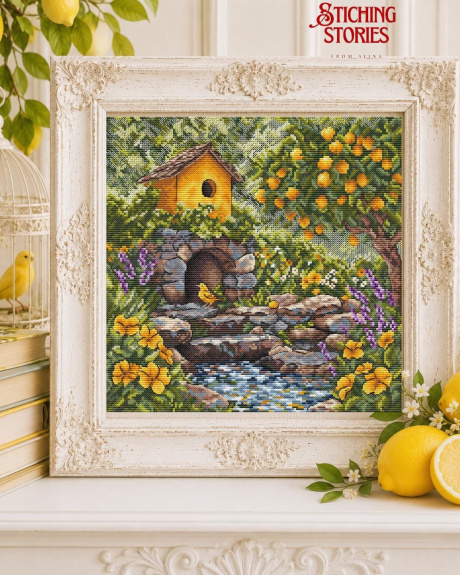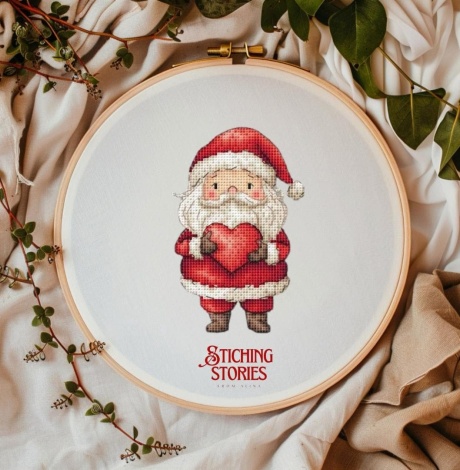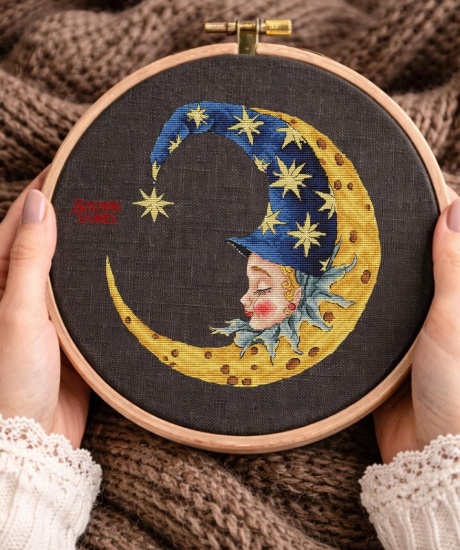
Look for a design up to 60–70 stitches per side, a palette of 5–12 colours, no fractional stitches and no continuous backstitch outline. Difficulty isn't set by the subject but by four things: size, number of colours, extra techniques involved, and how close the shades sit to each other. A pretty butterfly at 200 stitches is harder work than a "boring" geometric at 50. That's what the best cross stitch patterns for beginners have in common.
Below: the numbers, an honest time estimate, subjects that forgive mistakes, and what to check in a listing before buying.
What actually makes a chart difficult
Beginners tend to judge a chart by eye — it "looks simple" or it "looks hard". In practice the effort comes down to measurable properties, and all of them appear in the listing or on the information page of the PDF.
| Property | Comfortable for a first project | What adds difficulty |
|---|---|---|
| Size | Up to 60–70 stitches per side | Over 150 stitches per side |
| Colour count | 5–12 | Over 25 |
| Fractional stitches | None, or a handful | Along every diagonal edge |
| Backstitch | Short lines, or absent | A full outline around every element |
| Coverage | Solid blocks of colour | Scattered single stitches on bare fabric |
| Gradients | Contrasting neighbouring colours | Four or five close shades of one tone |
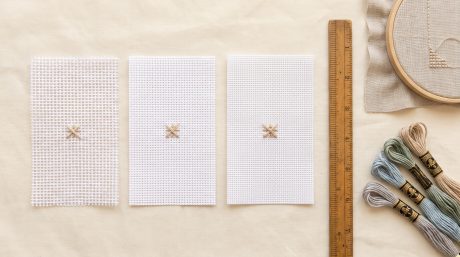
| Fabric | 14-count Aida, light coloured | 18-count, or dark fabric |
A few notes on the table. Fractional stitches are triangles filling half a square to smooth diagonals — technically easy, but they demand attention in every area they appear. Backstitch is a one-strand outline worked after all the crosses; short lines cause no trouble, while an outline around every single petal adds substantially to the hours. And scattered single stitches on bare fabric are more irritating than solid fill, because each one has to be counted out separately.
How many stitches and colours to start with
A 60×70 design covers up to 4,200 grid squares. Fewer get stitched, since part of the fabric stays bare — a typical small subject works out at roughly 2,000–3,000 stitches. Early on an hour covers 100–200 stitches, so a piece like that runs about 10–20 hours: two to three weeks of evening sessions.
That estimate is deliberately honest, and it matters. Most abandoned projects aren't given up because they were hard, but because expectations didn't match: someone planned for a weekend and lost interest in week three. If you want something finished quickly, take 40×40 stitches or less — that's a few hours rather than a few weeks.
One more piece of advice that rarely gets said out loud: don't buy several charts at once. Files bought "for later" create an illusion of progress and a quiet pressure at the same time, because the piece in your hoop starts competing with the next one. One chart at a time works better, and the files aren't going anywhere.
Colours follow a similar rule. Each new colour means another skein, another symbol in the key, and another stop to rethread the needle. Five to twelve colours give plenty of variety; twenty-five turn stitching into logistics, with half the time spent hunting for the right thread.
Easy cross stitch PDF patterns: what to check in a listing
You can tell more before buying than it might seem. Size is always given in stitches, and that's the number to work from — centimetres depend on fabric count and say nothing about the volume of work. Beside it you'll usually find the DMC colour count, which is the second most useful figure.
Next, check whether extra techniques are mentioned. If the listing names fractional stitches, backstitch or French knots, the piece will ask more of you than plain counted cross stitch. That's not a reason to walk away, but it's worth knowing in advance.
The design image itself is informative too. Crisp boundaries between colours mean the chart will be easy to read; blurred transitions point to gradients built from close shades. Stitching Stories by Alina designs are drawn by hand rather than converted automatically from photographs, so they don't contain the stray single pixels that have to be hunted down one at a time. Technical questions about file formats are collected in the answers to common questions.
Subjects that forgive mistakes
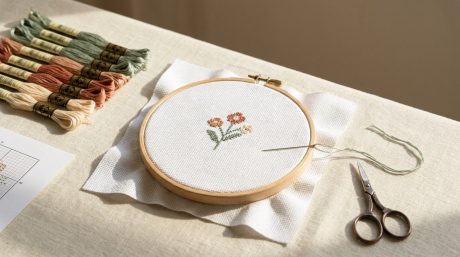
Geometric patterns, silhouettes, lettering, samplers, botanical motifs with clean outlines, simple stylised animals — all of these work well for a first piece. What they share is large uniform areas and visible boundaries between colours. Miscount by a square and you'll see it straight away, while it's still easy to fix.
Harder subjects are worth postponing not for what they depict but for how they're built. Portraits and realistic animals rely on dozens of close skin or fur tones, where being one row out changes an expression. Water, mist and sky are made of smooth transitions with no landmarks to count against. Large landscapes add a third problem — sheer size: they run for months, and the first mistake surfaces a week after you made it.
There's a middle path: take a small fragment of a subject you love instead of the full scene. One flower rather than a bouquet, one bird rather than a woodland view. Compact designs are gathered in the Mini category, and they're the ones that most often become a first finished piece.
A checklist for choosing a first chart
- Up to 60–70 stitches per side; for a quick result, 40×40 or less.
- A palette of 5–12 DMC colours.
- No fractional stitches or French knots mentioned in the listing.
- Backstitch absent, or limited to short lines.
- Clear boundaries between colours in the design image, without blurred transitions.
- A black-and-white symbol version included, in case the shades turn out to be close.
- Time estimated honestly: 10–20 hours for a 60×70 design.
- A subject you like enough to return to over several weeks.
- Light-coloured 14-count Aida already bought or on the list.
The straightforward place to start is a design under 60–70 stitches with a compact palette. Those are gathered in the Mini category, and if you want something specific, look at a design using only a few colours or browse the full catalogue against the checklist above.